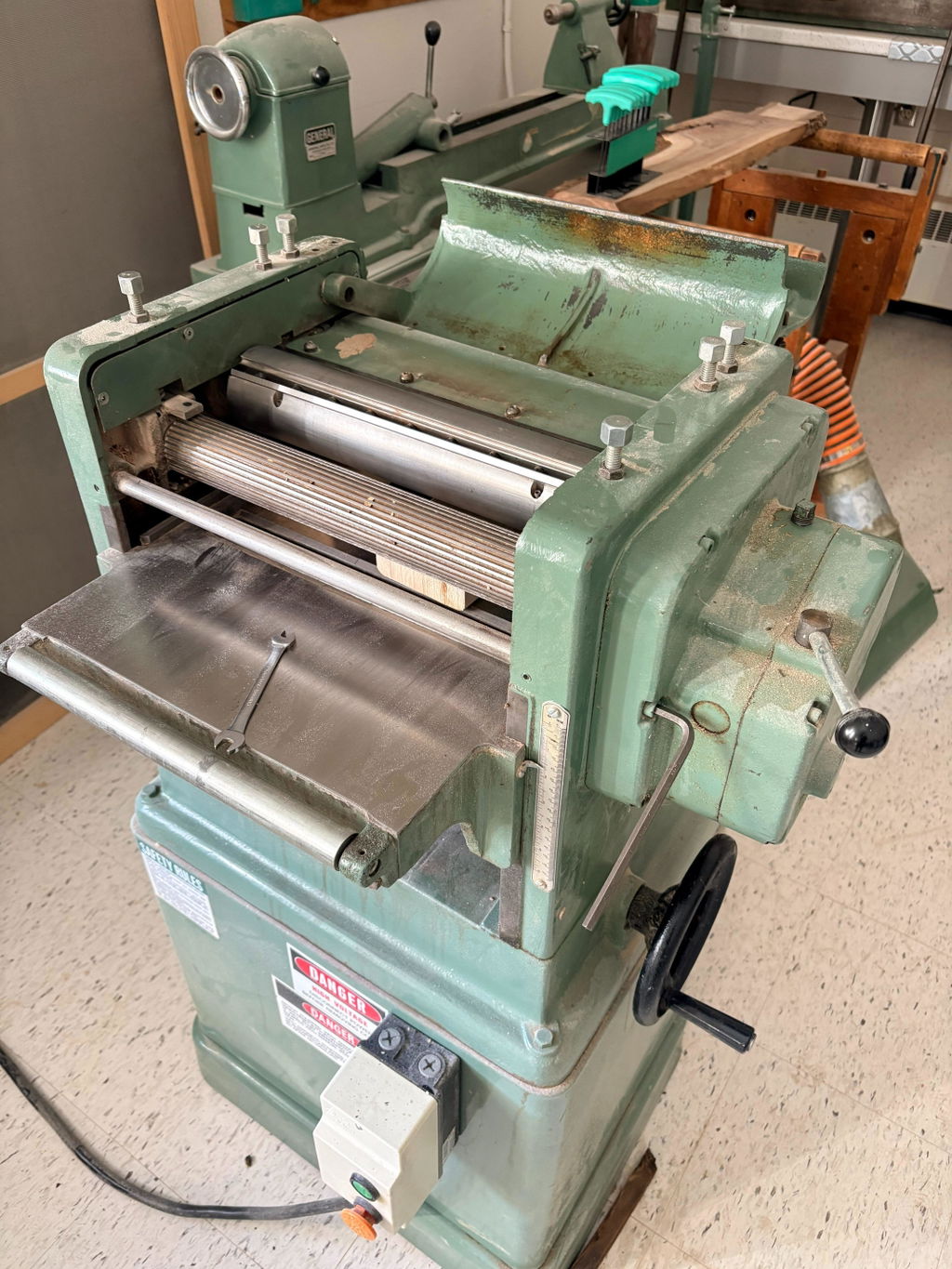
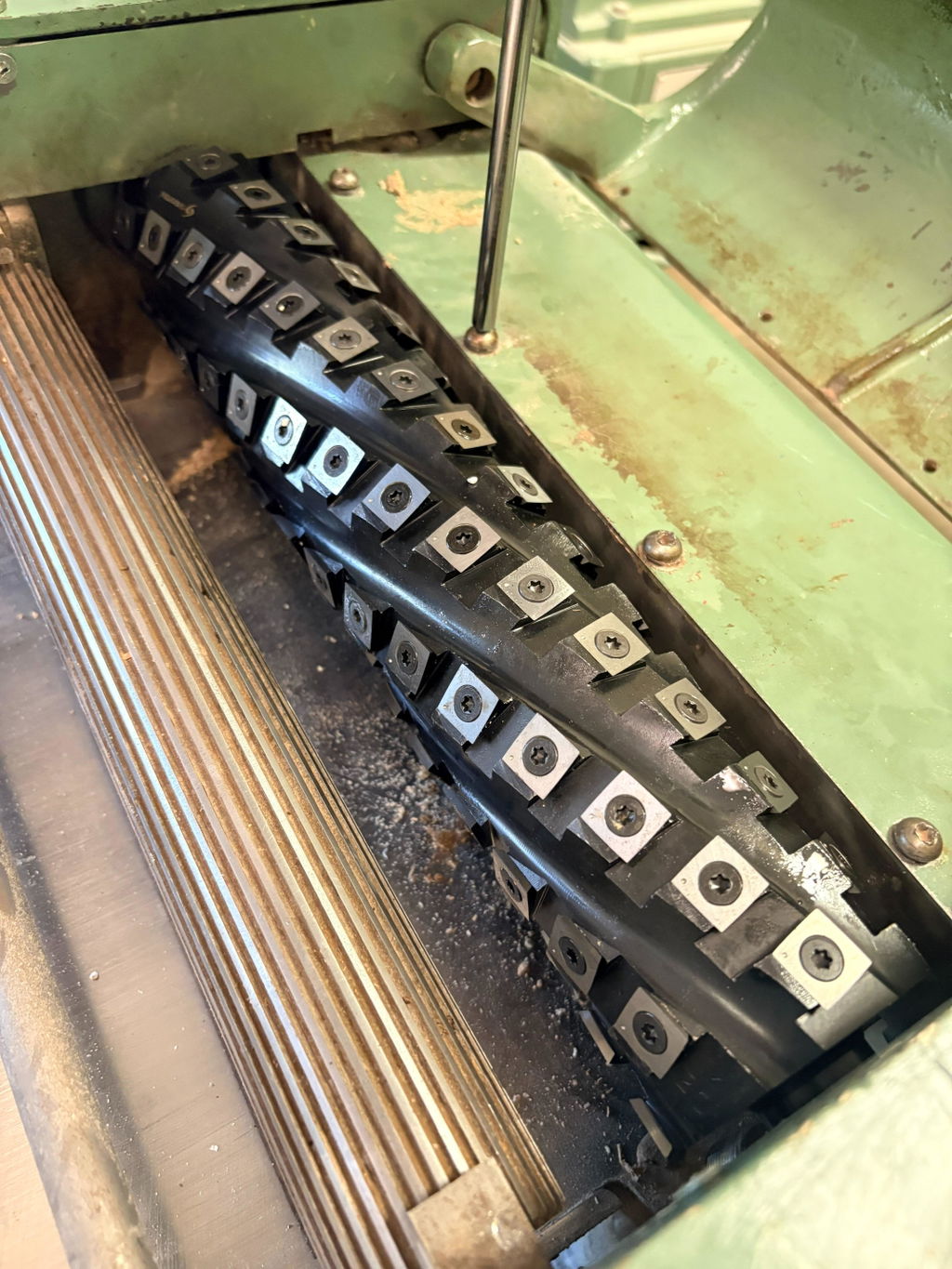
Tête de coupe hélicoïdale pour raboteuse General 130 14 pouces - 6 spirales, 90 couteaux
Améliorez votre machine avec les têtes de coupe hélicoïdales Sheartak pour profiter de ces avantages clés :
-
Finition supérieure : Obtenez une finition lisse et sans arrachement. Les inserts décalés et inclinés travaillent selon un motif hélicoïdal pour offrir des effets de coupe par cisaillement, même sur les bois durs très figurés.
-
Bruit réduit : La tête de coupe hélicoïdale minimise considérablement le bruit en maintenant un contact constant avec la planche, en utilisant moins de couteaux.
-
Fraises en carbure de tungstène longue durée : Fabriquées en carbure de tungstène massif, ces fraises sont plus résistantes et restent affûtées beaucoup plus longtemps que les lames traditionnelles en acier rapide. Si un bord devient émoussé ou ébréché, il suffit de le faire pivoter à 90° pour révéler un nouveau bord tranchant. Chaque insert comporte quatre arêtes de coupe, offrant jusqu'à quatre utilisations.
-
Installation rapide et facile : Les inserts en carbure rectifiés avec précision sont interchangeables, et le processus est simple. Il suffit de desserrer les vis, de faire pivoter les inserts à 90° et de resserrer en quelques minutes. Le système de verrouillage à trou conique assure un positionnement précis.
-
Extraction efficace des poussières : Les petits inserts en carbure enlèvent un matériau plus fin, ce qui simplifie l'extraction des poussières.
-
Rentable : Les têtes de coupe hélicoïdales sont plus économiques à long terme, se rentabilisant souvent rapidement grâce à leur durabilité et leurs performances.
Le kit de tête de coupe hélicoïdale comprend :
- Bloc de couteaux en acier allié à haute résistance
- 90 inserts en carbure préinstallés
- 5 inserts en carbure supplémentaires et 5 vis supplémentaires (pièces de rechange gratuites)
- 1 clé
Instructions d'installation :
Pour installer la tête de coupe, vous devrez peut-être la faire passer à travers l'alésage du bloc de paliers dans le carter de la machine. Si la tête de coupe ne rentre pas avec les inserts en carbure déjà installés, vous devrez peut-être retirer temporairement un ou deux jeux complets de couteaux pour l'installation. Une fois la tête de coupe positionnée, réinstallez les inserts en carbure et serrez-les à un couple de 48-52 livres-pouces.
Bien que l'installation des inserts en carbure soit un processus simple, l'attention aux détails est essentielle. Pour des instructions complètes, veuillez télécharger le manuel et regarder la vidéo d'accompagnement pour un guide étape par étape.
Manuel
Vidéo
Do I need to replace the original bearings?
If the bearings in your machine are in good condition, they can be reused by carefully removing them with a bearing or pulley puller. However, if the bearings are tightly pressed onto the shaft, removal may cause damage. To minimize this risk, we recommend replacing old bearings with our greased and sealed bearings, designed for long-lasting performance. For a smooth upgrade, we suggest adding the bearings to your shopping cart before completing your purchase.
We provide premium bearings from NSK, SKF, NTN, FAG, Timken. They are renowned for their high quality and performance, designed to provide durability and reliability in various applications
Do I need to to Add a Few Boxes of Carbide Inserts
We provide 5 carbide inserts and 5 screws as spare parts. However, many of our customers choose to purchase additional boxes, as the shipping costs for separate purchases can make it less economical.
Do I need a Torque Wrench?
To securely lock the carbide inserts, we recommend applying a torque of 48 to 52 Pound-Inches (or 5.42 to 5.88 Newton-Meters). (Note: 1 Newton-Meter is equal to 8.851 Pound-Inches, and 1 Pound-Inch is approximately 0.113 Newton-Meters.) It is crucial not to apply excessive torque, as this could cause the carbide inserts to crack or explode. On the other hand, using too little torque may result in the inserts not being properly secured, which could lead to cracks, shattering, or uneven height on the cutter block, causing ridges or lines on the board.
If one person is responsible for maintaining the machine, they can typically apply the same torque consistently without a torque wrench. However, when multiple people are involved in machine maintenance, ensuring uniform torque application can be challenging. For consistency and peace of mind, we recommend using a torque wrench.
What kind of steel the cutter block is made of?
The cutter block is constructed using GB/T 40Cr, a structural alloy steel of the same caliber as ASTM grade 5140, AISI 5140, SAE 5140, DIN 41Cr4, BS 41Cr4, JIS SCr440, and EN 41Cr4.The primary components of this steel are as follows: carbon (C) at a range of 0.37-0.44%, silicon (Si) between 0.17-0.37%, manganese (Mn) within 0.50-0.80%, and chromium (Cr) from 0.80-1.10%.
In terms of physical properties, this steel exhibits a tensile strength range of 115-234σb/MPa, a yield strength of 2σ 0.2 ≥/MPa, and an elongation capacity of 65 δ5≥ (%). It also has a HBS range of 123-321 and a HRC rating of 30.
This alloy steel is frequently utilized in low to moderately stressed components for machines, engines, and vehicles.